
Aflame
by Pico Iyer

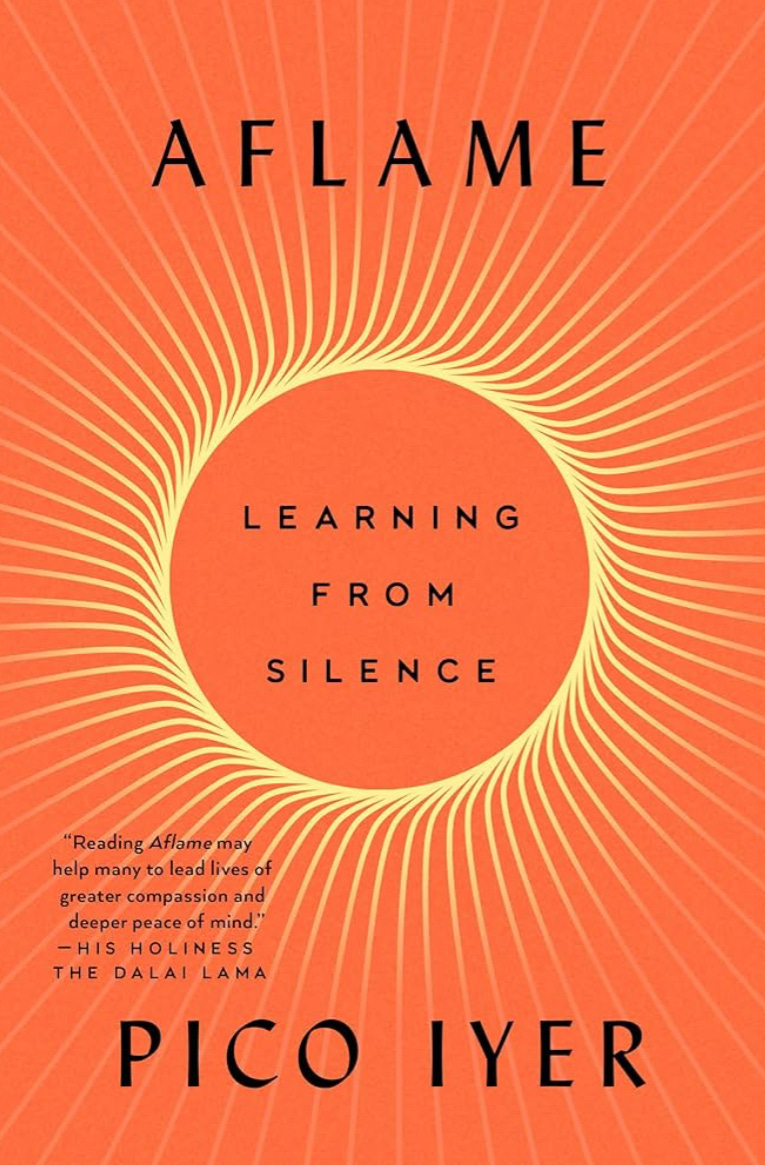
What does one say about a book about silence? You may have heard Pico Iyer interviewed multiple times on Krista Tippet’s On Being podcast. If you need to have the TV on at home, the radio on in the car, and ear buds in when you are running; or if you’re immersed in the tsunami of information online about politics or other matters that encourage obsessive consumption of audio, video, and text – then a book on silence might be a welcome change of pace.
Anne Lamott said, “I can’t imagine a better time for this book to come out — it helped me find my way back to the truth of my spiritual identity. Aflame offers ageless counsel about the power of silence and what it can teach us about how to live, how to love, and, ultimately, how to die.”
Aflame is a kind of memoir of Iyer’s long affinity for quiet places and people. Over the last 30 years or so, he became a fixture at a Benedictine (Catholic) monastery in Big Sur, California, friends with a certain Zen (Buddhist) monk in Los Angeles who was also a celebrated musician, and also friendly with a Vedanta (Hindu) convent in the Santa Barbara area. Iyer has been known primarily as a travel writer over his long career. But even a migrating albatross needs to land occasionally. For Iyer, home base is variously in Japan, where his partner lives; Santa Barbara, where his mother lives; or one of these monasteries on the California coast.
Iyer exemplifies the broad-mindedness often associated with travelers and mystics. His affinity for monasteries is not confined to one religion or doctrine. Early on, he tells of overhearing a visitor to the monastery bookstore. She commented unfavorably on the presence of books by Buddhist authors. The monk who was minding the store replied, “If you think those guys are evil, we’re probably not for you.”
Iyer conveys how this contemplative thread weaves through his life: in his relationships with fellow visitors; in the fires that change and threaten the lives of monks and others on the California coast; the joys and difficulties of a monastic life; and how it affects his non-silent life. For anyone who romanticizes the contemplative life, or sees it as something for already saintly people, these vignettes challenge both of those ideas. What's it like, to spend time with those who have made silence a cornerstone of their lives and spirituality? He points out that T.S. Eliot said that no one “can hope to be completely free who lives within reach of familiar habits and urgencies.” (Iyer has a wonderful repertoire of literary references. Silence does afford one more time to read.) Alternative lifestyles challenge our assumptions about how mandatory or healthy “normal” is. We are reminded that we have options.
This isn’t a self-help book, and he doesn’t proselytize. He doesn’t say that shushing will solve your problems, but shares it as something he cherishes.
If you’d like to “go and do likewise,” be quick about it; many monasteries and convents are closing as their membership ages and dwindles. Yeats wrote, “We can make our minds so like still water that beings gather about us that they may see, it may be, their own images, and so live for a moment with a clearer, perhaps even with a fiercer life because of our quiet.” Iyer seems to have found that to be true.